

Understanding menstrual experiences of women across life stages
Design research - Menstrual health - Care - Becoming aware
We know that menstruation shapes how women experience their daily lives. We have period tracking apps, clinical guidelines, and awareness campaigns. But rarely a deep, documented understanding of how these experiences actually change across life stages. This research is set to understand, across ages 18-45, what that journey really looks like.
What I wanted to understand
-
How do menstruation and the body mediate a woman's menstrual experience throughout their life?
-
How can knowledge about menstruation enhance that experience?
-
How can menstrual care be a preventive measure for abnormal uterine bleeding?
-
What is called a "normal period"?
I used mixed-methods in this research, but why?
Menstruation is deeply subjective — and for many, rooted in cultural practice and personal identity. While period conversations are becoming more normalised, they remain sensitive and emotionally loaded in many contexts. Because experience involves not just the physical, but also the emotional and social, a single method cannot capture its full complexity.
I used a multi-method approach — both in how I collected data and how I analysed it. Some methods came from outside design research entirely, because the research demanded it. I believe we don't always have to follow textbook methods — sometimes we have to invent our own.
Since the core of this research was understanding how menstrual experiences change across life stages, I spoke with women aged 18 to 45 — and that age range itself shaped why multiple methods were necessary
Here's how I gathered and analysed
And why each approach was necessary
Part 1: The Gathering
Survey
The survey was my first step towards gathering people for my research, to have a high-level understanding of their menstrual awareness and experience. The survey was sent out to women aged 18 to 45 through a referral method. For a total of 15 questions, I got 38 responses.
Here are some of the survey questions,
-
At what age did you have your first period talk?
-
When you first learned about periods, what were your initial conversations about them?
-
How would you describe about periods to your girl child, if you have one?
-
Do you track your periods?
Activity - Love letter or Breakup letter
Menstruation is deeply personal, and many people still feel uncomfortable discussing it openly. To truly understand their experiences, it was important to create a space where participants felt at ease and not overly self-conscious. As a researcher, this meant finding approaches that encourage openness.
To achieve this, I designed an activity where participants wrote either a love letter or a break-up letter to their periods. This format allowed them to remain anonymous and express their thoughts freely about their menstrual experiences.
Through this activity, I was able to capture their emotional relationships with menstruation.
The participants were women aged 18–28, and the responses included 16 break-up letters and 21 love letters.

Fig.01: Set-up of the activity

Fig.02: Participants taking part in the activity
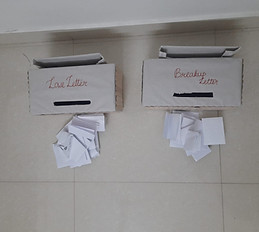
Fig.03: Responses from the activity
In-depth interviews
The survey and activity helped identify participants who were open to in-depth interviews about their menstruation experiences. Informed consent was obtained, ensuring anonymity throughout.
The interviews were structured around five key parameters: knowledge of menstruation, period experiences, tracking practices, seeking care, and self-care. Additional questions were included for specific age groups—women in their 30s were asked about pregnancy, and those in their 40s about menopause.
Conducted via online meetings and phone calls, the interviews allowed for free-flowing conversations, enabling follow-up questions and richer insights. In total, 16 women were interviewed, with four participants from each age group (18–20, 20s, 30s, and 40s). Additionally, 3 OBGYN doctors and 2 menstrual educators were interviewed to bring in expert perspectives.
Part 2: The Analysis
Thematic analysis
I used this method to analyse the open-ended survey responses. I read through the responses multiple times, coded them, and grouped them into themes. This approach was chosen due to the volume of responses and the recurring patterns that emerged.
For example, as shown in Fig. 04, I identified themes for the question, “How would you explain menstruation to your child, if you had one?” This helped me understand the participants’ mindsets and their perceptions of menstruation.

Fig.04: Thematic analysis of an open-ended survey question
Sentiment analysis
Sentiment analysis is generally used to analyse the tone of the digital text of a brand - whether it is positive, neutral, or negative. As the love letter or break-up letter involved a lot of emotions, I used this approach to analyse the emotions from the letter.
A quote from love letter
“I like that you give me the rest I need, I deserve every month. (Even though it hurts sometimes) Lazing on my bed for 3 days gives me comfort. It’s like I can do anything, I can treat myself.”
A quote from break-up letter
“I wish I never had you. I’m not even sure I want to have children. Please stop ruining my clothes.”

Fig.05: A snapshot of sentiment analysis
Content analysis
The interview transcripts were read to identify the concepts that were spoken about across different age groups. This analysis allowed me to discover patterns across the age groups. I used this method to analyse the interview transcripts from participants, doctors, and menstrual educators.

Fig.06: A snapshot of content analysis of a participant's interview transcript
Mapping what I found
After analysing the 3 methods, I came up with a journey map and an experience map to understand how experience changes across life stages.
Journey map
To understand the patterns across life stages, I made 3 journey maps that focus on different age groups and stages - menarche to pregnancy (age 18 to 25), pregnancy (30s), peri-menopause to menopause (40s). Three maps put together outline the sequence of the journey across the menstrual timeline, along with the needs and pain of women during each stage.

Fig.07: Journey map of women aged 18-25

Fig.08: Journey map of women in their 30s

Fig.09: Journey map of women in their 40s
Experience map
While the journey map gives the sequence of what happens at each stage, the pain and needs, the experience map shows what it feels like to live through menstruation at each stage, capturing the physical and emotional dimensions of it.

Fig.10: Experience map
The reality that the data revealed
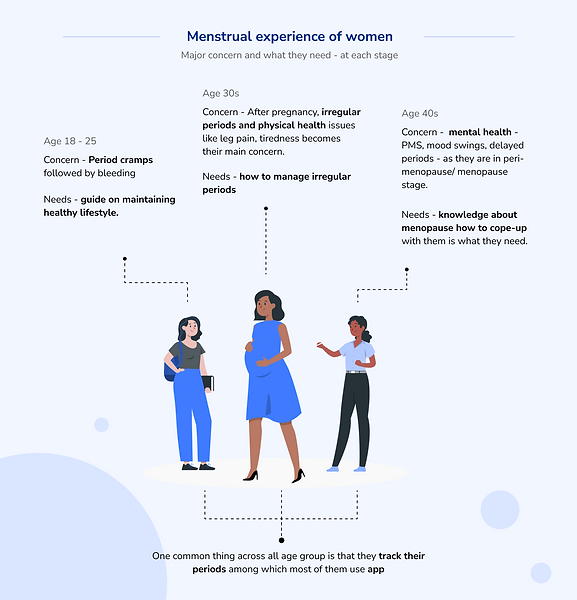
Fig.11: Infographic of key findings
Through this image, we can see that concerns vary across age groups. In particular, many women experience irregular cycles after pregnancy and gradually notice changes in their physical well-being. Women in their 40s showed significant gaps in awareness about perimenopause, often confusing its symptoms with stress or ageing.
The experience map (Fig. 10) clearly highlights which aspects hold the highest severity for each age group. Just as we see varying concerns, the needs also differ across age groups. However, they all fall under a common category: health communication. Across all stages, women are primarily seeking guidance to cope with their concerns.
Another interesting finding from the break-up letters was that women in their late teens (18–19) often expressed strong negative feelings towards menstruation due to the pain and discomfort it causes. Many associated menstruation only with pregnancy, without acknowledging its role in overall health—for instance, the contribution of estrogen to bone health, and how bone density begins to decline after menopause, which can lead to knee and leg pain in the 50s.
What this research opens up
1. Health communication
What this research explicitly shows, is that, there's a significant need for health communication designed specifically for women about how to cope with irregular periods and how to handle menopausal symptoms, what to expect in peri menopause stage and when to consult the doctor.
2. Period tracking app - does it cater to different menstrual stages?
As the data shows that each age group experiences menstruation differently, we can validate whether the tracking apps in the market cater to those needs. If not, we can set an approach to design those apps that will cater to the needs of women. Given that the majority of the women in the survey stated that they use tracking apps, we can make use of the apps to educate women about menstrual health.
3. Education and awareness
Understanding menstrual experiences across life stages can inform how menstrual health should be taught, what is relevant at which life stage.
4. Healthcare practice
This research can inform how health check-ups for women, especially related to menstruation, can be formulated. This can also give better insights to the doctors about the menstrual experience of women, apart from clinical aspects, which in turn can also help them make their diagnosis approach more informed.
5. Policy & Public health
Many workplaces still do not have paid menstrual leave every month. This can certainly inform workplace policy related to menstruation and public health programmes
My learnings and reflection
This research has given me deeper insights not only into how women experience menstruation, but also into how to approach a problem that is deeply rooted in emotions, bodily experience, and social taboo. Such problems require a different approach to data collection and analysis, which I was able to navigate. It also helped me learn how to interact with people while discussing such a sensitive topic.
If I were to expand this research, I would include women from diverse regional and cultural backgrounds. Currently, this study focuses only on women in an urban setting with a limited number of participants. To gain richer insights, it would be important to gather a larger dataset and validate the findings with medical professionals. I would also like to study menstrual practices and the bodily experiences of menstruators across both urban and rural contexts.